Dip Variations: Build a Chest and Triceps That Actually Show
Dips are the upper body squat. Here is how to program every dip variation for maximum chest and tricep development, from bodyweight to weighted.
Why Dips Belong in Every Push Program
Dips are the most underrated upper body compound movement. They train the chest, triceps, and anterior deltoids in a single closed-chain movement that allows you to move your entire bodyweight through a significant range of motion. The bench press gets all the attention because you can load it with plates and it tests well. Dips build the muscle that makes your bench press go up, and they do it with less shoulder stress when performed correctly.
The reason dips are underutilized is simple: they are hard. A bodyweight dip requires you to press roughly 70 percent of your bodyweight. For a 180 pound lifter, that is 126 pounds on day one with no ramp-up. If you weigh 220, you are pressing 154 pounds before you add external load. This means overweight or undertrained lifters often cannot do a single rep and conclude that dips are not for them. That is like concluding squats are not for you because you cannot do one with your bodyweight. The solution is not to skip the exercise. The solution is to build up to it.
EMG data shows that dips produce higher tricep activation than any other bodyweight or free weight pushing exercise, including close-grip bench press. The lower pec activation is also substantial, particularly in the leaning-forward chest dip variation. For lifters who want visible lower chest development and thick triceps, dips deliver both in one movement. No other single push exercise matches this combination.
The carryover to other pressing movements is significant. Weighted dips build the tricep strength that limits bench press lockout and the lower chest mass that creates the illusion of a fuller, rounder pec. If your bench stalls at the top half, your triceps are the bottleneck and dips are the fix. If your chest looks flat from the side, dips fill in the lower pec in a way that flat bench pressing alone does not.
Chest Dip Versus Tricep Dip: Two Different Movements
The way you position your body during a dip determines which muscles dominate the movement. A chest dip and a tricep dip are the same exercise with different technique, and they produce meaningfully different training effects. Understanding the distinction lets you program dips for the specific adaptation you need.
For a chest dip, lean your torso forward at roughly a 30 to 45 degree angle from vertical. Flare your elbows slightly outward, not tucked to your sides. Allow your shoulders to move through a larger range of motion by descending until you feel a deep stretch across your lower chest. The forward lean shifts the load from the triceps to the sternal fibers of the pectoralis major. This is the variation that builds the lower chest shelf that separates a decent chest from a great one.
For a tricep dip, stay as upright as possible. Keep your elbows tucked close to your ribcage. Lower yourself until your upper arms are parallel to the floor, then press back up. The upright posture minimizes chest involvement and maximizes tricep recruitment through the full range of motion. This is the variation that builds tricep mass and pressing power. If you want bigger arms and a stronger lockout, this is your default.
Most lifters default to something in between: a moderate lean with moderate elbow flare. This is fine for general training, but if you are programming dips as a primary movement, you should choose the variation that addresses your weak point. Chest weak? Lean forward. Triceps weak? Stay upright. Do not fall into the trap of doing the same variation every session and wondering why your weak points do not improve.
The Progression: From Zero Reps to Weighted Dips
If you cannot do a single bodyweight dip, start with bench dips. Place your hands on a bench behind you, feet on the floor, and lower yourself until your upper arms are parallel. This reduces the load to roughly 40 to 50 percent of bodyweight and allows you to build the base strength and movement pattern. Three sets of 10 to 15 reps is your benchmark. When you can do that easily, move on.
The next step is band-assisted dips on parallel bars. Loop a resistance band around the bars and place one knee on the band. The band provides the most assistance at the bottom, where you are weakest, and less at the top, where you are stronger. This matches the strength curve of the exercise and builds strength in the hardest part of the movement. Start with a thick band and progress to thinner bands as your strength increases. When you can do three sets of 8 with a light band, you are ready for unassisted dips.
Negatives are the bridge between assisted and unassisted dips. Jump to the top position and lower yourself as slowly as possible. Aim for a 5 to 8 second negative. This builds eccentric strength, which is the precursor to concentric strength. Three sets of 3 to 5 slow negatives, twice a week, will get most lifters to their first bodyweight dip within two to four weeks.
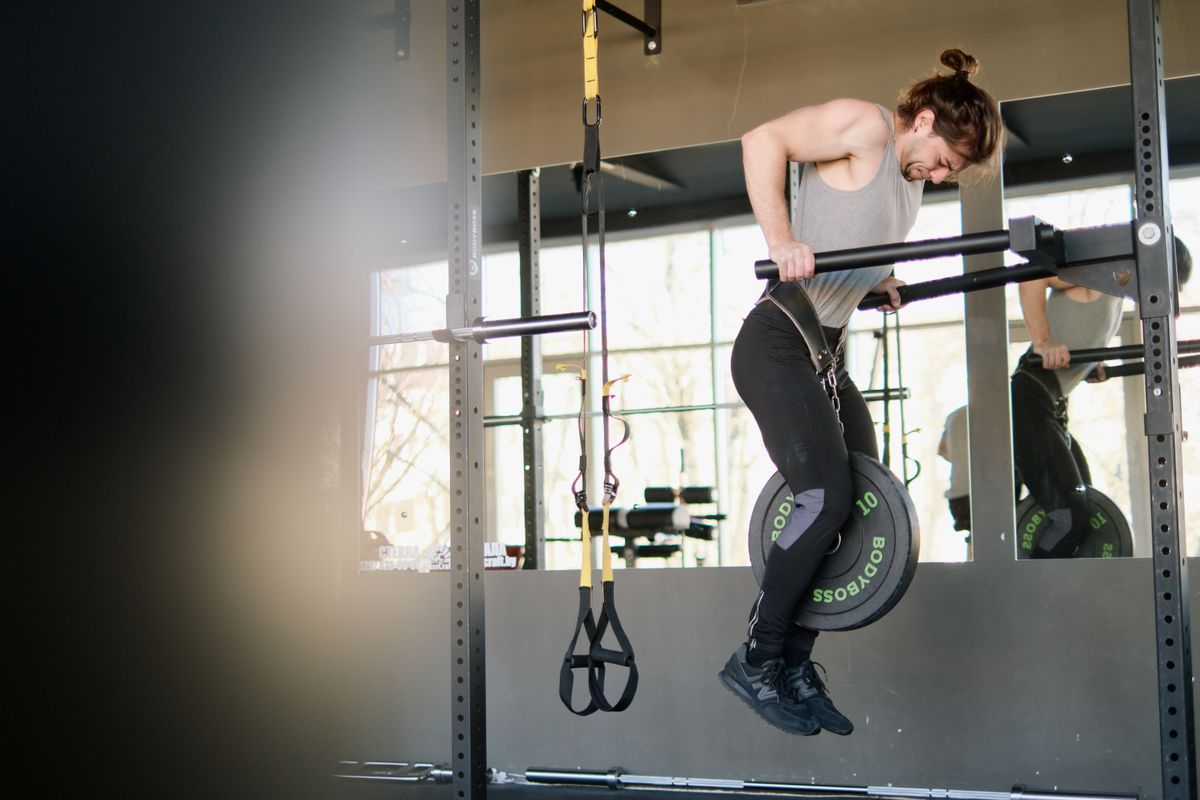
Once you can do sets of 8 to 10 bodyweight dips, add weight. Use a dip belt with plates or hold a dumbbell between your feet. Start with 10 to 25 pounds and progress in small increments. The rep range for strength is 3 to 6 weighted reps. For hypertrophy, 8 to 12. Do not add weight before you have earned it with clean bodyweight reps. Sloppy weighted dips are a shoulder injury waiting to happen.
Programming Dips Into Your Training Week
Dips can serve as a primary movement or an accessory. If you are running an upper/lower split, program dips as your primary push movement on one upper day and as a secondary movement on the other. If you are running a push/pull/legs split, dips belong on push day after your bench press or overhead press, depending on which you are prioritizing. If you are running a body part split, dips are the first exercise on chest day or tricep day.
For strength, run weighted dips in the 3 to 6 rep range for 4 to 5 sets. Rest 3 to 4 minutes between sets. Add weight progressively, aiming to add 2.5 to 5 pounds per week. When you stall, deload by 15 percent and rebuild. A reasonable intermediate goal is a weighted dip with 50 percent of bodyweight added for a set of 5. That is a 180 pound lifter dipping with 90 pounds for 5 reps. If you can do that, your chest and triceps are developed well beyond average.
For hypertrophy, run bodyweight or lightly weighted dips in the 8 to 15 rep range for 3 to 4 sets. Rest 90 seconds to 2 minutes between sets. Use the chest dip variation on chest-focused days and the tricep dip variation on arm-focused days. The volume accumulates quickly because dips are a compound movement, so watch your total pushing volume across the week. If you are also benching, overhead pressing, and doing tricep accessories, adding 12 sets of dips on top may push your recovery past its limit. Start with 6 to 8 sets per week and adjust based on how your joints and performance respond.
Shoulder health is the limiting factor for most lifters on dips. If you feel sharp pain in the front of your shoulder during the descent, you are either going too deep, leaning too far forward, or your shoulders lack the mobility for the movement at your current bodyweight. Reduce the range of motion, adjust your torso angle, or drop to an assisted variation until the pain resolves. Do not train through shoulder pain. The shoulder joint does not forgive accumulated abuse. Protect it and it will let you train for decades. Ignore it and it will end your pushing career.
Dips are not optional for serious upper body development. They close the gap between what pressing alone can build and what a complete push program delivers. Start where you are, progress methodically, and add weight when you have earned it. Your chest and triceps will be the proof that you did the work.