How to Build Bigger Quads: Best Exercises and Training Guide (2026)
Discover the most effective quad exercises and training techniques to build serious lower body strength and size. This comprehensive guide covers proven methods for maximum quad hypertrophy.

Your Quads Are Not Growing Because You Are Not Training Them Like They Matter
You have been skipping leg day in practice if not in intention. Every week you tell yourself this is the week you hit quads hard, and every week something gets in the way. A shoulder tweak. A lack of time. A preference for exercises that let you check your phone between sets. Your quadriceps are the largest muscle group in your body, and they deserve more than the half-hearted attention you have been giving them. This guide is for lifters who are done making excuses. You want bigger quads, and you want them built the right way, with a barbell on your back and a logbook in your hand.
Building bigger quads is not complicated. It requires understanding anatomy, selecting the right exercises, programming them intelligently, and executing with consistency over months and years. Most lifters fail because they chase variety instead of volume, skip the movements that actually work, and do not track their progress with any rigor. If you are willing to commit to a structured approach, the quads you have always wanted are waiting for you.
The Anatomy of Your Quadriceps: Know What You Are Training
Before you load a barbell, you need to understand what you are trying to stimulate. Your quadriceps femoris is a four-headed muscle group that covers the entire front of your thigh. The rectus femoris runs down the middle and is the most visible quad muscle when developed. The vastus lateralis sits on the outer thigh and creates that sweeping outer sweep that separates a good quad from a great one. The vastus medialis is the teardrop on the inner knee, and it contributes to overall quad fullness when trained properly. The vastus intermedius lies beneath the rectus femoris and contributes to overall quad thickness.
Each head of the quadriceps has a primary function: knee extension. Every exercise that builds bigger quads does so by loading this extension pattern under load. The rectus femoris also crosses the hip joint, which means it contributes to hip flexion. This is why exercises with a greater range of motion at the hip often produce a stronger stretch on the rectus femoris. Understanding this matters for exercise selection. If you only train knee extension in a limited range of motion, you will develop some of the quad but leave significant gains on the table.
Most lifters undertrain the vastus lateralis because they focus exclusively on exercises that allow the knee to travel forward without restriction. The squat pattern, when performed with a high bar position and upright torso, emphasizes the vastus lateralis and rectus femoris more heavily than a low bar or front squat variation. This is not a minor detail. The vastus lateralis is responsible for roughly 40 percent of total quadriceps cross-sectional area. Neglecting it means neglecting the bulk of your quad tissue.
The Exercises That Actually Build Bigger Quads
You do not need a dozen exercises to build bigger quads. You need the right movements loaded progressively over time. Everything else is noise that distracts from the work that matters. The following exercises are the foundation of any serious quad development program. Master them before you add anything else.
The back squat is the king of quad builders when executed correctly. The high bar back squat, performed with an upright torso and significant knee flexion, places the majority of load on your quadriceps. Most lifters make the mistake of treating the squat as a glute and hamstring exercise because they have been told to sit back and push their hips. This technique shifts emphasis away from the quads and onto the posterior chain. If your quads are lagging, try a more upright torso position and allow your knees to track forward over your toes. You will feel your quads working in ways you have not felt before. Depth matters. Going to parallel or below ensures full quad activation throughout the entire range of motion.
The front squat is a different animal that deserves its own place in your program. Because the bar is held in front of the body, the torso must remain more upright to maintain balance. This increases knee flexion relative to hip flexion, which places a greater demand on the quadriceps. The front squat is technically demanding and forces you to stay more upright, making it an excellent quad-dominant variation. If your front squat is weak, your quad development is suffering. Most lifters avoid front squats because they are harder to perform and more demanding on the core. That is exactly why they work.
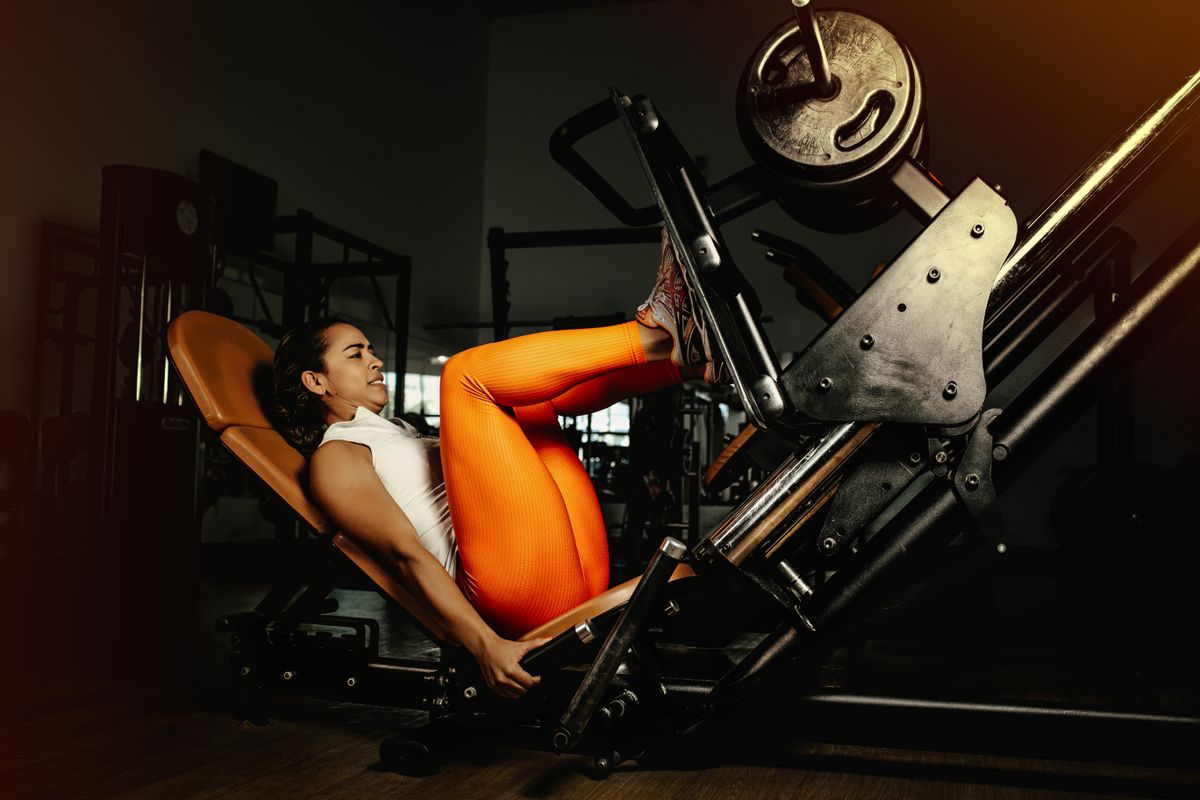
The leg press is an underutilized tool for quad hypertrophy that deserves more respect. When performed with a high foot placement and a full range of motion, the leg press allows you to load your quads heavily without the technical demands of a barbell squat. Most lifters set their feet too low on the platform, which turns the leg press into a glute and hamstring exercise. Set your feet high, keep your lower back pressed into the pad, and focus on a full stretch at the bottom. The leg press is not a cop-out for people who cannot squat. It is a legitimate hypertrophy tool that deserves a place in your training rotation.
Leg extensions are often dismissed as an isolation exercise that cannot build real muscle. This is wrong. Leg extensions provide direct tension on the quadriceps through a full range of motion that is difficult to replicate with compound movements. They are particularly effective for targeting the vastus medialis, the teardrop-shaped muscle that gives the quad a complete, finished appearance. Use leg extensions as an accessory movement after your compound work. Perform them with controlled eccentrics and a full squeeze at the top of each rep. They will not replace squats, but they will add quality quad volume that compounds over time.
The Bulgarian split squat is an excellent unilateral exercise that builds bigger quads while addressing strength imbalances between legs. The rear foot-elevated position forces the front leg to handle all the load through a deep range of motion. This movement challenges quad strength through positions that standing exercises cannot replicate. Most lifters treat the Bulgarian split squat as a glute exercise because they do not stay upright enough. Lean your torso forward only slightly and focus on driving your knee forward over your toes. Your quads will feel this in ways that bodyweight lunges never delivered.
Hack squats and pendulum squats provide a machine-based alternative for quad isolation that allows you to load heavily without the spinal compression of a barbell. These machines keep the torso more upright than a traditional back squat, which places greater emphasis on knee extension and quad recruitment. They are not the foundation of your program, but they are valuable for adding volume and providing a different training stimulus that contributes to overall quad development.
Programming Your Quad Training for Maximum Growth
Exercise selection is only half the battle. How you program those exercises determines whether your quads grow or plateau indefinitely. Building bigger quads requires managing training volume, frequency, intensity, and recovery across weeks and months of consistent effort.
Train your quads with sufficient frequency. The quadriceps respond well to being trained two to three times per week, depending on your overall training split. If you are following a push/pull/legs structure, hitting quads twice per week with different exercise variations is optimal. If you are doing an upper/lower split, training quads twice per week with separate lower body sessions works well. Higher frequency allows you to accumulate more quad volume per week without the fatigue that comes from doing everything in a single session. Your quads are a large muscle group. Give them the attention they deserve spread across multiple sessions.
Volume is the primary driver of hypertrophy, and quad training requires significant volume to stimulate growth. For each quad session, aim for ten to twenty hard sets of quad-dominant exercises, measured as sets taken within a few reps of failure. This does not mean twenty sets of the same exercise until your nervous system is fried. Distribute the volume across compound and isolation movements. Start with your heaviest compound lifts, then move to accessory work that targets specific areas of the quad that need more development.
Rep ranges for bigger quads should include a mix of moderate and higher rep work. Compound movements like squats and leg press respond well to rep ranges of five to twelve. Isolation exercises like leg extensions can be taken to higher rep ranges of fifteen to twenty-five for metabolic stress and time under tension benefits. Do not get stuck in a single rep range. Varying your rep ranges across training cycles ensures you are stimulating growth through multiple mechanisms.
Progressive overload is non-negotiable. If you are lifting the same weight for the same reps next month that you are lifting today, your quads are not growing. Track your training in a logbook. Record sets, reps, and weights. Add weight when you hit your target reps, or add reps when you cannot add weight. The compound movements should see steady increases over time. Leg extensions and accessory work can progress more slowly, but they should still show improvement over weeks and months.
Common Mistakes That Are Sabotaging Your Quad Development
You have been making mistakes in your quad training, and they have cost you months of potential growth. Identifying and eliminating these errors is the fastest path to bigger quads.
The first mistake is partial range of motion on compound lifts. Quarter squats do not build bigger quads. They build quarter squat muscles and leave the rest of your quadriceps untrained. Every rep of every set should reach at least parallel depth, where your hip crease drops below the top of your knee. If you cannot hit depth, reduce the weight and earn the right to go heavier by controlling a full range of motion. Partial reps are a waste of time that your quads will never forgive.
The second mistake is neglecting unilateral work. If one leg is significantly weaker than the other, your overall quad development is capped by your weaker side. Bilateral exercises like squats hide strength imbalances because the stronger leg compensates for the weaker one. Bulgarian split squats, lunges, and single-leg leg press variations expose these imbalances and allow you to address them directly. Your body is not symmetrical, and your training should account for that.
The third mistake is undertraining the vastus medialis. Most lifters focus on the sweep of the vastus lateralis and the overall size of the rectus femoris but forget about the teardrop. Leg extensions with a wider foot placement and a deliberate squeeze at the top of each rep target the vastus medialis more effectively. Front foot-elevated split squats also place greater demand on the vastus medialis due to the forward knee position. If your inner quad is underdeveloped, your quads will never look complete.
The fourth mistake is inconsistent training frequency. Your quads grow when they are trained regularly with adequate recovery between sessions. If you train legs hard once every ten days, you are leaving gains on the table. Two to three quad sessions per week, distributed evenly across your training week, maximizes protein synthesis and hormonal response. Consistency over months is what builds bigger quads, not occasional hero sessions followed by weeks of avoidance.
The fifth mistake is ignoring nutrition and recovery. You cannot build bigger quads in a caloric deficit unless you are a relative beginner with significant body fat to lose. For most lifters, building quad mass requires eating at maintenance or a modest surplus with adequate protein intake. Sleep quality directly affects recovery and muscle protein synthesis. If you are training your quads hard but sleeping five hours per night, your results will reflect that neglect. Quads are built in the gym, but they grow while you sleep.
Your Quad Development Starts Now
You have the information you need. The exercises are proven. The programming principles are straightforward. What remains is execution. Building bigger quads requires showing up consistently, loading the bar appropriately, pushing sets close to failure, and tracking your progress with a logbook that you actually review. There are no shortcuts. There are no secret exercises that will bypass the fundamentals. There is only hard work applied intelligently over an extended period.
Start your next lower body session with a plan that prioritizes quad-dominant movements. If you are a low bar squatter, try switching to a high bar or front squat variation and notice the difference in quad activation. Add leg extensions at the end of your session and track your sets and reps. Increase your quad training frequency to twice per week minimum. Give it three months of consistent effort and measure your results. If your quads are not growing, you are either not training hard enough, not eating enough, or not being patient enough. The answer is almost always one of those three.
Your quads are waiting. Stop making excuses and load the bar.