Best Quad Exercises for Leg Hypertrophy: Science-Based Guide (2026)
Discover the most effective quad exercises for building massive leg muscle. This guide covers top compound movements, isolation techniques, and science-backed training strategies for maximum quad hypertrophy.

Your Quads Are the Foundation of Leg Strength. Train Them Like It.
You can have the widest shoulders and the thickest back in the gym, but if your legs look like someone bolted two chicken legs onto a torso, the physique falls apart. Nobody walks past the leg press and thinks "that person is serious about training." And yet, the vast majority of lifters in any commercial gym are walking around with well-developed upper bodies and quads that would embarrass a distance runner.
This is not an aesthetic argument. This is a performance and health argument. Your quadriceps consist of four distinct heads, the rectus femoris, vastus lateralis, vastus medialis, and vastus intermedius, that collectively make up the largest muscle group in your body. They extend your knee, stabilize your patella, and generate the force necessary for every vertical movement you perform. Strong quads protect your knees, improve your vertical jump, and contribute more to your total lower body volume than any other muscle group.
If your quad development is lagging, your training is lagging. Here is what the research actually says about building them.
The Anatomy of Quad Growth: What Science Tells You
You cannot train what you do not understand. Your quadriceps are not a monolithic block of tissue that responds uniformly to any knee extension. Each of the four heads has a specific function and different mechanical advantage depending on joint angle and load position. The rectus femoris crosses both the hip and knee joint, making it active during hip flexion movements in addition to knee extension. The vastus lateralis and vastus medialis are primarily responsible for patellar tracking and medial lateral stability. The vastus intermedius lies beneath the rectus femoris and is recruited throughout the entire range of knee extension.
Research using electromyography has consistently shown that different quad exercises produce different activation patterns across these heads. A study published in the Journal of Strength and Conditioning Research demonstrated that the vastus lateralis shows higher activation during parallel bar dips compared to traditional leg extensions, while the vastus medialis demonstrates greater activation during terminal knee extensions performed at angles beyond 90 degrees of knee flexion. This matters because it means a well-designed quad program should include exercises that stress the muscle group across multiple joint angles and load profiles.
The angle of hip flexion during quad exercises also influences which heads are most active. When your hip is extended, the rectus femoris is stretched and more involved in the movement. When your hip is flexed, the rectus femoris is shortened and contributes less force. This is why front squats, where your torso remains more upright and your hip is flexed, place greater relative tension on the vasti muscles compared to back squats where the more forward torso angle allows the rectus femoris to contribute more force.
Quad Exercises Ranked by Mechanical Effectiveness
Not all quad exercises are created equal. Some movements load the muscle group through a longer range of motion with consistent tension. Others allow you to lift heavier weight but with compromised mechanics and shorter effective ranges. Here is how the evidence stacks up.
Barbell back squats are the king of quad development for overall muscle building. They allow you to load the heaviest weights, recruit the most motor units, and stimulate significant systemic hormonal responses. The research consistently shows that compound movements with heavy loading produce superior hypertrophy outcomes compared to isolation work alone. Your quads are heavily involved throughout the entire descent in a back squat, particularly if you are hitting proper depth with your hips traveling below parallel. If you are quarter squatting and calling it leg day, you are leaving substantial hypertrophy potential on the platform.
Front squats deserve more attention than they typically receive. The anterior load position forces your torso to remain more upright, which shifts greater force demand onto your quadriceps and away from your posterior chain. Many lifters find they feel front squats more in their quads and less in their glutes and lower back. The tradeoff is that you typically cannot lift as much weight as back squats, but the quad-specific stimulus may be superior for your purposes. If your goal is maximal quad hypertrophy and you are avoiding front squats, you are making a mistake.
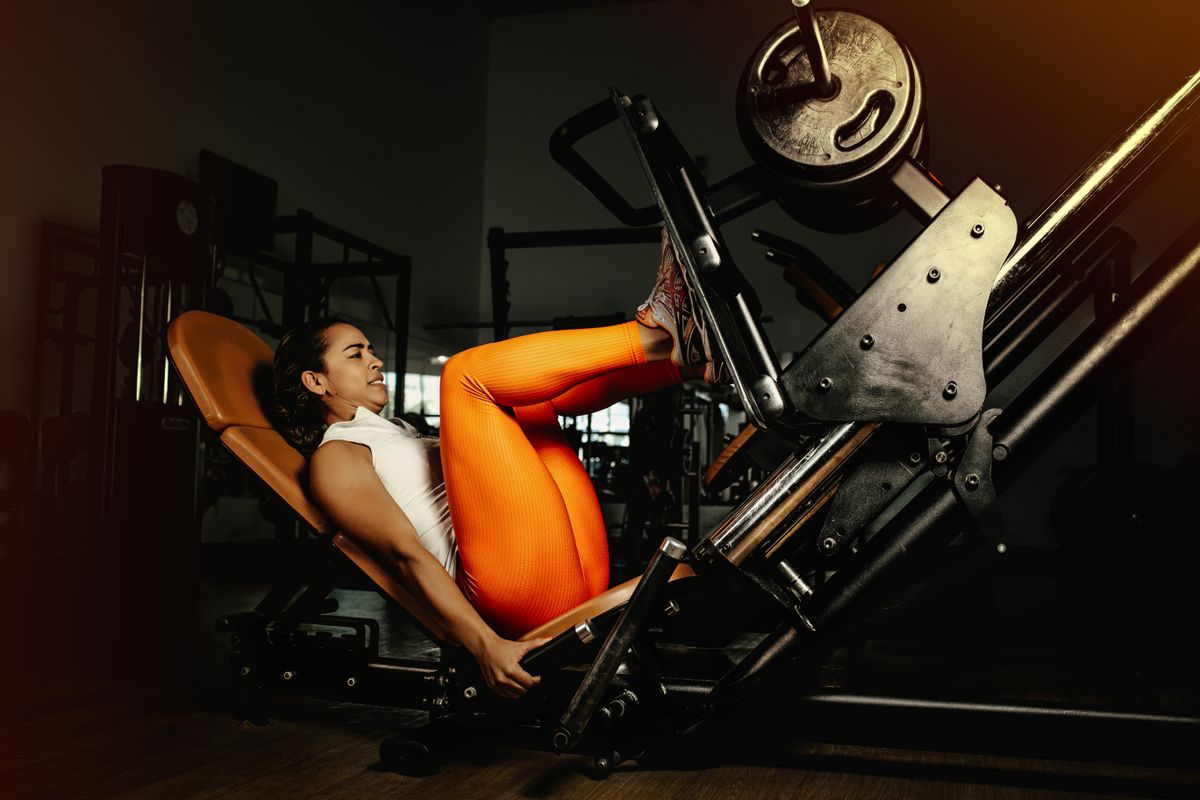
Leg press variations offer exceptional quad stimulus with less spinal loading than free weight squats. The key is foot placement and range of motion. High foot placement on the leg press platform with a narrow stance emphasizes quad involvement over glute contribution. The longer range of motion available on a horizontal leg press compared to a 45-degree press allows for greater muscle fiber recruitment through a fuller contraction. Do not lock your knees out at the top. Maintain tension throughout the entire repetition.
Hack squats provide a mechanical advantage that allows you to overload the quadriceps at angles that may be difficult to target with free weights. The linear leg press machine offers similar benefits. Both movements allow your knees to travel forward without the same spinal demands as barbell work. The hack squat machine, specifically, positions your center of mass behind the foot platform, creating a constant quad tension throughout the movement that many lifters find superior for muscle targeting.
Leg extensions are a legitimate quad isolation tool despite what strength coaches who only care about functional fitness claim. Yes, they are an isolation movement. Yes, they should not be the foundation of your quad training. But when used to add volume after your compound work, leg extensions allow you to specifically target the vastus medialis and achieve higher activation of the quad group at terminal ranges where compound movements become biomechanically disadvantaged. Perform them at the end of your session when your quads are pre-fatigued from compound work. This is when isolation tools provide the most value.
Programming Quad Training for Maximum Hypertrophy
Knowing which quad exercises to perform is only half the equation. Volume, frequency, and progressive overload determine whether you actually grow. The research on hypertrophy is clear on several points. Total weekly sets for a muscle group should fall between 10 and 20 sets per week for most trained individuals, with 12 to 16 sets being a reliable starting point. Below 10 sets and you are likely leaving growth on the table. Above 20 sets and you enter diminishing returns territory with increased recovery demands.
For quad hypertrophy specifically, I recommend structuring your weekly volume as follows. Perform two to three compound quad movements as the backbone of your program. Each compound movement should be performed for 3 to 5 working sets in the 6 to 12 rep range. This rep range provides an optimal balance between mechanical tension and metabolic stress, both of which drive hypertrophy. Then add 2 to 3 sets of quad isolation work at the end of your session, targeting 10 to 15 reps. This isolation volume allows you to add mechanical tension to the quad group without the systemic fatigue that comes from additional compound work.
Frequency matters for quad development because the muscle group responds well to higher training frequencies compared to slower recovering muscle groups like the lats or biceps. Training quads twice per week allows you to distribute your volume across more sessions, potentially increasing total weekly quality sets. Some advanced trainees benefit from three sessions per week, particularly if using a split routine where quads are trained when they are fresh. The key is ensuring you are recovering sufficiently between sessions. If your knees are cranky, your quads are constantly sore, or your performance is declining across sessions, you are overtraining. Back off the volume and add recovery.
Progressive overload for quads follows the same principles as any other muscle group. You need to either add weight, add reps, add sets, or improve technique and range of motion over time. If you are performing the same weight for the same reps on the same exercises week after week, your quads are not growing. They are maintaining. Track your training. Write down your sets and reps. Compare week to week and ensure you are progressing. A logbook does not lie. Your memory of what you lifted does.
Common Quad Training Errors That Are Costing You Growth
Most lifters who lack quad development are not lacking genetic potential. They are making systematic errors in their programming and execution. Here is what to eliminate.
Short range of motion is the most common mistake. Quarter squats, partial leg presses, and knee extensions performed through the last 30 degrees of extension provide minimal stimulus for actual muscle growth. Your muscle fibers only experience tension through the range they are lengthened and shortened. If you are not reaching adequate depth in squats or using the full available range on machine exercises, you are training a shortened version of your quads. The muscle does not know you are cheating. It only responds to the tension it experiences. Increase your range of motion and watch your quad development accelerate.
Excessive posterior chain bias is another frequent error. Hip hinge movements are valuable. Deadlifts, Romanian deadlifts, and good mornings build the glutes and hamstrings that contribute to athletic performance and lower body aesthetics. But if your leg program consists primarily of hip hinges with minimal quad-focused work, your quadriceps will not develop. Balance your posterior chain training with equal or greater quad volume. The glutes and hamstrings are often the limiting factor in posterior chain movements anyway. Stronger quads can help you overcome that limitation and lift heavier hip hinges.
Neglecting terminal knee extension work leaves gains on the table. The vastus medialis, the tear-drop shaped head on the inside of your quad, is most active when your knee is nearly fully extended. Standard squat patterns do not provide adequate tension at these terminal angles because the patella tracks into the femoral groove and reduces mechanical advantage. Single leg extensions, sissy squats performed through a full range, or sled leg presses performed with a full contraction all place significant tension on the quad at these ranges. Include this work if you want complete quad development rather than a muscle group that looks strong in the middle but flat near the knee.
Poor nutrition and insufficient protein intake will sabotage your quad training regardless of how perfectly you program your sessions. Muscle protein synthesis requires amino acids, primarily leucine, in adequate quantities. Aim for at least 1.6 grams of protein per kilogram of bodyweight daily, with higher intakes around 2.2 grams per kilogram being beneficial for many lifters. Your quads are large muscles. They require substantial amino acid availability to repair and grow. If your diet is not supporting your training, your training is not supporting your goals.
Build Legs That Match the Rest of Your Physique
Quad development is not optional if you are serious about building a complete physique. The lifters who look the best from every angle have built legs that match their upper bodies. The lifters who skip leg day eventually hit a wall where their upper body progress stalls because they lack the base of strength and systemic development that lower body training provides. Your body is not going to build the upper body you want while ignoring an entire muscle group that makes up roughly a third of your total skeletal muscle mass.
Start tracking your quad volume separately from your other leg work. Know how many sets you are performing per week for your quadriceps specifically. Apply progressive overload consistently. Use the exercises that actually stress the muscle group through adequate ranges of motion. The science of hypertrophy has answered most of the questions about how to build muscle. The gap between knowing and doing is where most lifters fail. Execute the programming. Trust the process. Your quads will grow when you give them a reason to.