Dumbbell Shoulder Press: Complete Guide for Upper Body Mass (2026)
Master the dumbbell shoulder press with expert techniques, optimal rep ranges, and programming strategies to build serious shoulder mass and pressing strength.
Why the Dumbbell Shoulder Press Outperforms Barbell for Upper Body Development
The dumbbell shoulder press is the single most effective overhead pressing movement you can include in your training program if your goal is building real upper body mass. Not aesthetics. Not the illusion of width. Actual functional muscle that carries over to every other pressing movement you perform. Most lifters default to the barbell press because it feels heavier and more impressive, but the dumbbell variation offers advantages that the barbell simply cannot replicate. Greater range of motion, independent arm strength development, and the ability to address muscle imbalances that the barbell allows you to hide. If your shoulders are lagging, the dumbbell shoulder press should be the cornerstone of your pressing work, not an afterthought.
Here is what this article covers: proper setup and execution, the mechanical advantages that make this movement superior for hypertrophy, programming variables that determine whether you build size or just maintain, common technique errors that stall your progress, and a framework for integrating this movement into your current program regardless of your experience level.
Anatomy of the Movement: What You Are Actually Training
The dumbbell shoulder press primarily targets the anterior and lateral heads of the deltoid, with significant contribution from the triceps brachii and the upper portion of the pectoralis major. The anterior deltoid receives the greatest load during the pressing phase, while the lateral head bears substantial responsibility for stabilization throughout the range of motion. The triceps handle the lockout phase and provide significant contribution throughout the movement, making the dumbbell shoulder press one of the most complete upper body pressing variations you can perform.
What separates the dumbbell press from its barbell counterpart is the contribution of stabilizer muscles. When you press with both hands fixed to a barbell, your body naturally gravitates toward the path of least resistance. The stronger arm takes more of the load. Weak points get bypassed rather than addressed. With dumbbells, each arm must independently control the weight through the entire range of motion. This means the stabilizer muscles in your shoulders, upper back, and rotator cuff are forced into action. The result is more balanced development and reduced risk of the asymmetries that plague barbell pressers.
The scapular muscles also play a critical role in the dumbbell shoulder press. Your traps and serratus anterior work to control the movement of your shoulder blades as you press and lower the dumbbells. This scapular control is absent in the barbell press, where the bar restricts natural movement patterns. Training with dumbbells develops the kind of shoulder stability that translates directly to better performance on every other pressing exercise you perform.
Setup and Execution: The Technical Foundation
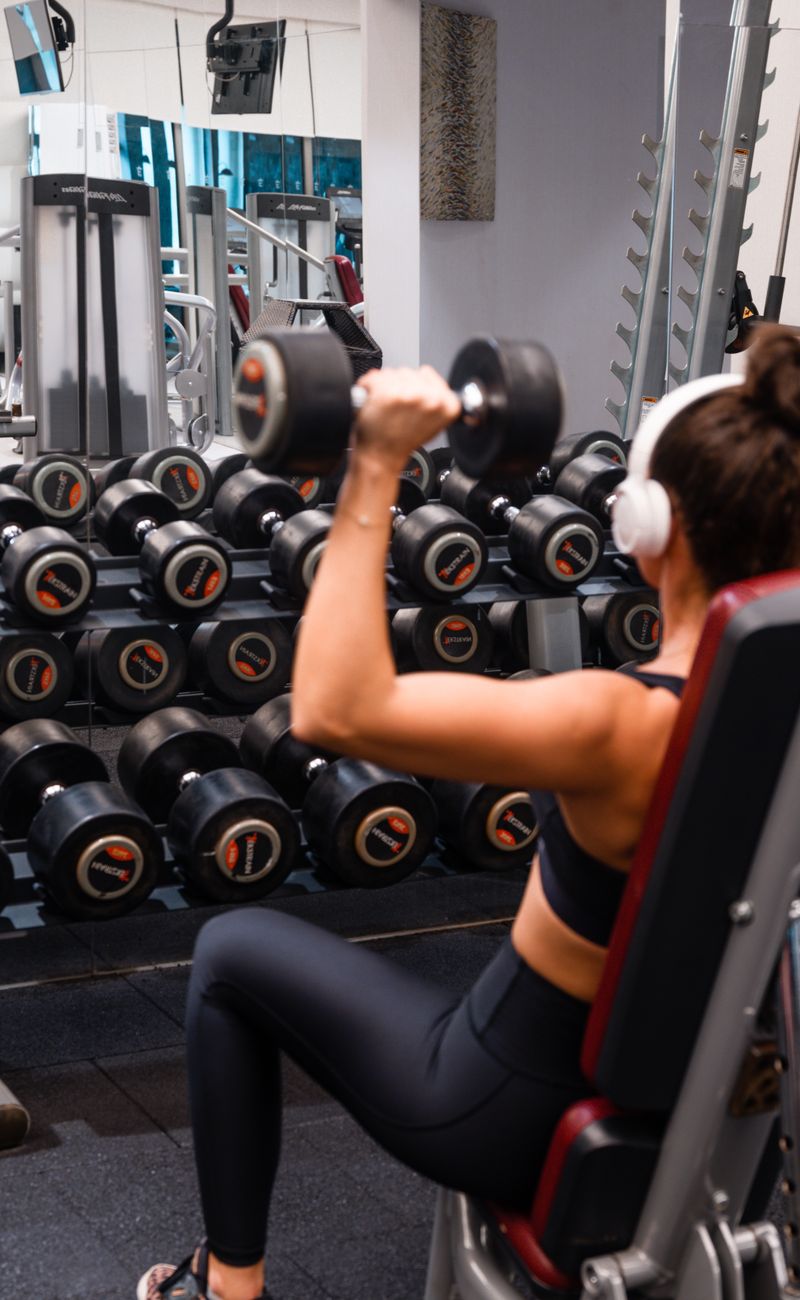
Proper setup determines everything in the dumbbell shoulder press. You cannot out-technical a poor starting position. Start by sitting on a bench with back support positioned at roughly 80 to 90 degrees. Higher back angles recruit less deltoid and shift emphasis toward the upper chest. Lower back angles can place excessive stress on your lumbar spine if you lack the mobility to maintain a neutral spine position. The 80 to 90 degree range is the practical compromise for most lifters.
Position the dumbbells at shoulder level with your palms facing forward. Your upper arms should be roughly parallel to the floor with elbows flared out at approximately 45 degrees from your torso. Do not let your elbows drop straight down toward your hips. This internally rotates the shoulder and reduces deltoid activation while increasing stress on the shoulder joint. The correct elbow position keeps your humerus in a more neutral alignment that protects the joint and maximizes muscle engagement.
Brace your core before you begin the press. This is not optional. The dumbbell shoulder press is a full body tension exercise. You need intra-abdominal pressure to support your spine and transfer force efficiently from your lower body into your upper body press. Without core bracing, you lose power output and expose your lower back to unnecessary stress. Take a breath into your belly, not your chest, and hold that pressure throughout the set.
Initiate the press by driving the dumbbells upward and slightly inward on a path that keeps them aligned over your shoulder joints. The dumbbells should not meet at the top. Allow a small gap between them. Forcing the dumbbells together at the top compromises shoulder position and reduces overall pressing power. Lock out with your arms fully extended but without hyper-extending your elbows. You want full tension on the target muscles at the top, not a relaxed joint.
Lower the dumbbells under control. Do not drop them. The eccentric portion of this movement is where significant muscle damage occurs, and muscle damage drives hypertrophy. A two to three second lowering phase serves your goals better than a controlled drop that takes half a second. Press from the rack position, not from a dead stop on your lap. Starting each rep from the bottom wastes energy and reduces training density without adding meaningful benefit.
Programming Variables: Sets, Reps, Frequency, and Progression
The dumbbell shoulder press responds to the same programming principles that govern all hypertrophy training, but some variables deserve specific attention. For pure mass building, the sweet spot sits between 8 and 12 reps per set with 3 to 5 total sets per session. This rep range allows you to use substantial weight while maintaining sufficient time under tension for maximum hypertrophic stimulus. Going below 6 reps shifts the stimulus toward strength adaptation with reduced time under tension. Going above 15 reps shifts toward metabolic conditioning with diminished mechanical tension on the target muscles.
Frequency depends on your total training volume and recovery capacity. Two sessions per week focused on the dumbbell shoulder press is sufficient for most intermediate lifters. This allows adequate recovery between sessions while maintaining frequent enough exposure to drive adaptation. If your overall training volume is high or your recovery capacity is limited, one session per week with higher volume per session is the more conservative approach. The key is consistency, not frequency. Training this movement twice per week for twelve weeks will produce better results than training it four times per week for three weeks before burning out.
Progressive overload in the dumbbell shoulder press requires creativity because dumbbells increment in fixed weight jumps. With barbells, you can add 2.5 pounds per side and continue progressing. With dumbbells, you might jump 5 or 10 pounds per hand. This means you need to use other progression mechanisms during plateaus. Adding a set, increasing reps, improving tempo, reducing rest periods, or increasing range of motion all constitute valid progressive overload when you cannot add weight. Do not let fixed dumbbell increments become an excuse for stagnation. Track your training log and ensure that some variable is improving every session.
Training to failure is not necessary for hypertrophy and carries unnecessary risk for an isolation oriented movement like the dumbbell shoulder press. Leave 1 to 2 reps in reserve on most sets. This maintains quality throughout the session, reduces accumulated fatigue that compromises subsequent training, and protects your shoulders from the end range failure positions that produce injuries. You do not need to grind every set to stimulus adaptation. You need consistent effort over time with adequate recovery.
Common Mistakes That Limit Your Progress
The first and most devastating mistake is using momentum instead of muscular force. Cheating reps by arching the back excessively, flaring the elbows wildly, or bouncing out of the bottom position eliminates the target muscle from the equation. Your body uses the momentum to complete the rep rather than your deltoids. If you are heaving the dumbbells up with your whole body, you are not training your shoulders. You are training momentum transfer and lower back compression. Keep your back tight against the pad, maintain a controlled tempo, and only use weight you can press with strict technique.
Another common error is incomplete range of motion. Partial reps in the dumbbell shoulder press produce partial results. If you are only pressing from the halfway point because the bottom position is too hard, you are abandoning the portion of the movement where the muscle is most loaded and most capable of generating tension. The bottom position of the dumbbell shoulder press is where the anterior deltoid experiences peak stretch. That stretch is not a passive sensation. It is an active hypertrophic stimulus that you forfeit when you start from a mid-range position. Lower under control to the rack position at shoulder level. That is where your deltoids are under the most mechanical stress.
Excessive elbow flare is a shoulder health issue that masquerades as a technical preference. When your elbows angle too far away from your body, you increase impingement risk on the rotator cuff tendons. The 45 degree flare that keeps your humerus roughly parallel to your torso at the bottom position is not conservative. It is correct. Your elbows should track in the same plane throughout the movement. If you find yourself needing to flare your elbows to press the weight, the weight is too heavy. Use a lighter pair of dumbbells and build proper motor patterns before loading the movement.
Integrating the Dumbbell Shoulder Press Into Your Program
The dumbbell shoulder press works best as a primary overhead pressing movement when paired with horizontal pressing work like bench press or pushups. The combination develops the three major heads of the deltoid through different vectors while building pressing strength that transfers to overhead positions. Place this movement early in your session when your energy reserves are highest. Overhead pressing is neurologically demanding and pairs poorly with exhausting compound movements that precede it.
For a push focused day, structure your training with the dumbbell shoulder press first, followed by horizontal pressing, then isolation work for the triceps and medial deltoid. This sequence lets you hit your highest priority movement while fresh, build compound pushing volume, and finish with targeted isolation that addresses any weaknesses you identified during the compound work. Three to four sets of 8 to 12 reps of the dumbbell shoulder press followed by 3 to 4 sets of a horizontal pressing variation and 2 to 3 sets of lateral raises completes a thorough shoulder pressing session in under 20 minutes.
Do not confuse the dumbbell shoulder press with a lateral raise performed in a pressing position. Some variation involves pushing a very light weight overhead with excessive body English and momentum. This is lateral raise technique performed at an overhead angle. It is not the dumbbell shoulder press and it does not produce the same stimulus. The dumbbell shoulder press requires substantial weight, strict execution, and genuine mechanical tension through a full range of motion. If your technique looks like a lateral raise with heavier dumbbells, you have misunderstood the movement.
The dumbbell shoulder press deserves a permanent place in your training program if you are serious about upper body development. It builds the shoulders that frame your chest, the triceps that complete your arms, and the stability that protects your shoulders during every other pressing movement. Barbell pressing has its place, but the dumbbell variation offers benefits that cannot be replicated with fixed implement training. Learn the movement correctly, program it intelligently, progress consistently, and watch your shoulders develop into the kind of detail that separates trained bodies from untrained ones. Your training log will tell you whether you are doing it right. Every session, record your sets, reps, and weight. Progress is measured in the logbook, not in the mirror.