Best Tricep Exercises for Bigger Bench Press (2026)
The triceps account for two-thirds of your upper arm and are critical for bench press strength. Build bigger arms and a stronger bench with these proven exercises.

Your Triceps Are The Missing Piece On Your Bench Press
If your bench press has plateaued and you keep chasing new programs, new accessories, and new techniques without looking at the obvious, you are wasting time. Your triceps account for roughly 60 percent of the force produced during the lockout phase of the bench press. When your bench stalls at the top, it is almost always your triceps giving out first. You can program your bench twice a week, deadlift to build your lats for better arch, and hammer your chest from every angle. None of it matters if your triceps cannot finish the lift. This article covers the best tricep exercises for a bigger bench press, ranked by specificity, programming dose, and what the research and practical experience both confirm works. Read it, apply it, and log your sets.
Why Triceps Dominate The Top Half Of The Bench Press
The bench press is not a single joint movement. It involves shoulder horizontal adduction, elbow flexion, and shoulder flexion depending on your grip width and arch. But the final 30 to 40 percent of the lift, the lockout, is almost entirely triceps. The longer your arm at the top, the more your triceps have to work. A narrow grip bench places more load on the triceps at the bottom. A wide grip shifts load to the chest. But regardless of grip, when you push through sticking points and hit full elbow extension, your triceps are doing the heavy lifting. If you cannot lock out a weight, your triceps are not strong enough for that load. Plain and simple.
Most lifters train chest and front delts heavily. They bench twice a week, do incline press, dumbbell press, and flyes until their pecs are fried. Then they wonder why their lockout feels weak and their bench keeps stalling. The answer is not more benching. The answer is specific tricep work that carries over to the lockout. You need exercises that load the elbow through full extension under load that mimics or exceeds what you face on the bench. Not isolation work that burns the muscle and does nothing for force production. Your triceps have three heads. The long head, lateral head, and medial head all contribute to elbow extension. But the long head is the largest and it crosses the shoulder joint, meaning it also assists in shoulder extension. This matters for your bench because the long head is most activated during overhead pressing and close grip pressing variations. The lateral head is most activated during locking out movements. You need both strong, but you need to prioritize the long head if your bench press has a sticking point in the bottom half, and the lateral head if you can never lock the weight out.
The Best Tricep Exercises For Bench Press: Ranked
The following exercises are ranked by transfer to the bench press. Specificity matters. An exercise that loads your triceps through a similar range of motion and joint angle as the top half of the bench will always outperform an isolation movement that does not challenge the lockout. Every exercise listed here has a direct line to a heavier bench. No fluff.
1. Close Grip Bench Press
This is the king of tricep exercises for bench press because it is literally a bench press with your hands closer together. The narrow grip increases elbow flexion and places more load on the triceps throughout the entire range of motion. Set your grip at shoulder width or slightly narrower. Lower the bar to your lower chest or upper abdomen. Press hard. Do not bounce the bar off your chest. Control the descent, drive hard from the chest, and lock out aggressively. Most lifters make the mistake of treating this like a light accessory movement. It is not. Load it heavy. Work in the 5 to 8 rep range with a pause on the chest. If you can strict press this for 5 reps and your bench is stuck at 225, your lockout will improve within 6 weeks.
2. Floor Press
The floor press eliminates the stretch reflex at the bottom of the movement and forces you to work through the entire range of motion under control. By stopping on the floor, you remove the contribution of your chest and front delts from the bottom portion of the lift and shift the load entirely to your triceps. This teaches you to generate force from a dead stop, which directly carries over to the lockout phase of the bench. Use a medium grip width. You can also add chains or bands to increase lockout difficulty. The floor press is particularly effective for lifters who have a strong bottom half of the bench press but stall at lockout.
3. JM Press
The JM Press is a hybrid between a bench press and a skull crusher. You lower the bar to your throat with your elbows tucked, just like a close grip bench. But instead of pressing the bar up, you allow your elbows to drift forward slightly as you lower the weight and then press it back up. This places a massive load on the elbow joint and forces the triceps to work through a full range of motion under heavy load. It is uncomfortable. It will tax your elbows. Do not use this as a primary movement for more than 6 weeks at a time. Run it in cycles. Three sets of 8 to 10 with a controlled eccentric and an aggressive lockout. If your elbows can handle it, this exercise will add serious mass to your triceps and power to your lockout.
4. Rolling Dumbbell Press
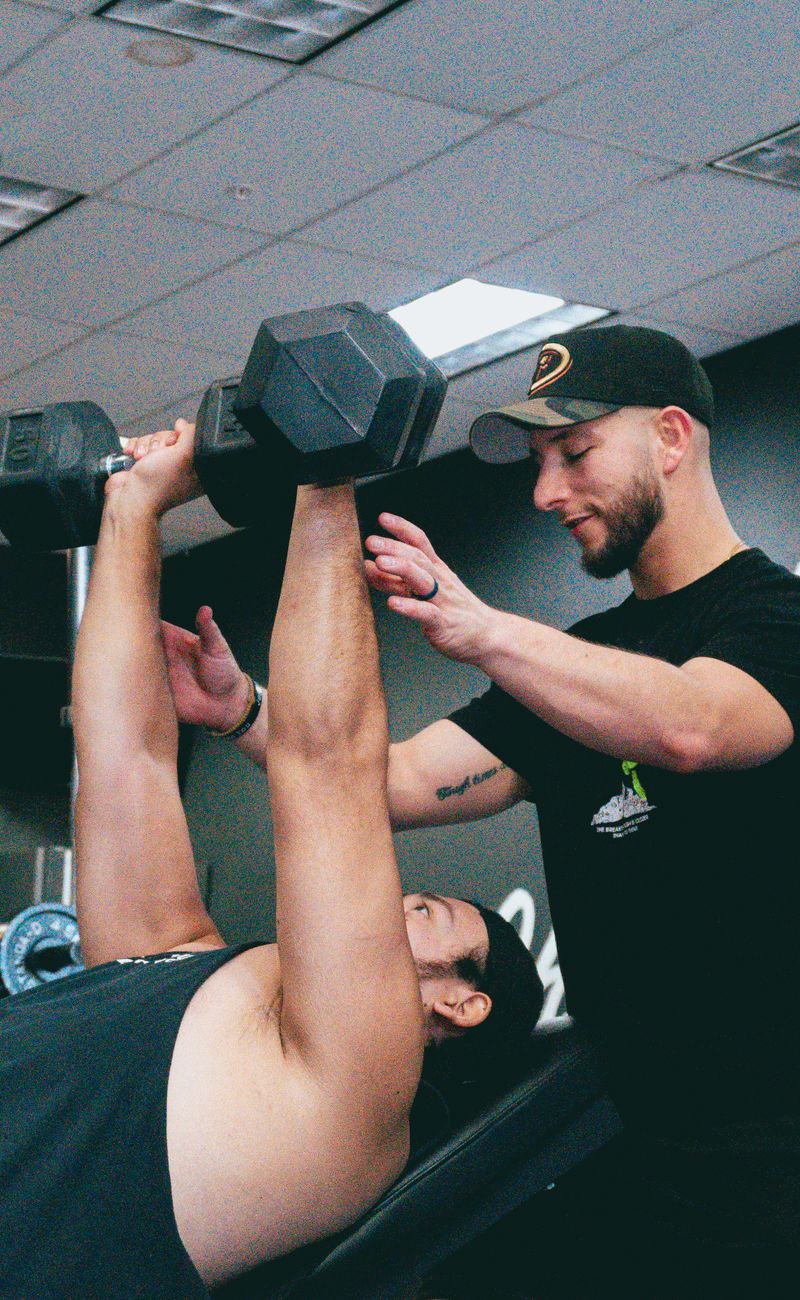
Lie on a flat bench with a dumbbell in each hand at arm's length above your chest. Lower the dumbbells out to the sides, keeping your upper arms vertical, until you feel a deep stretch in your long head. Then press the dumbbells back up while squeezing your triceps hard. The rolling motion engages the long head more aggressively than a standard dumbbell press. Use this as a hypertrophy focused movement in the 10 to 12 rep range. It is safe for elbows when performed correctly and it builds the long head that contributes to lockout strength.
5. Overhead Tricep Extension
Overhead extensions, whether with a dumbbell, cable, or barbell, are one of the best ways to target the long head of the triceps. The overhead position stretches the long head through a full range of motion and places it under load in a lengthened position, which research suggests drives more muscle growth. For bench press carryover, use a rope or a barbell with a narrow grip. Lean slightly forward to shift load from your shoulders to your elbows. The overhead extension will not make you a better bencher directly, but it builds tricep mass and long head strength that contributes to lockout power over time. Treat it as a hypertrophy tool, not a strength builder. High rep range, strict form, and full stretch every rep.
6. Skull Crushers
Skull crushers are a time tested tricep isolation exercise. They load the elbow through a full extension under control. The key word is control. Do not let the bar fall on your forehead. Lower the weight with your elbows locked in position, bring the bar to your forehead or just above it, and press back up. Use an ez bar or a dumbbell to reduce elbow strain. Skull crushers are best used as a hypertrophy movement in higher rep ranges. They do not carry over to bench press strength as directly as the pressing variations listed above, but they build tricep mass and work capacity that supports heavier training.
Programming Your Tricep Work For A Bigger Bench
Knowing the best tricep exercises means nothing if you do not program them correctly. Most lifters either do too much tricep work and end up with elbow tendinitis, or they do too little and never develop the lockout strength they need. Here is how to structure your tricep training to support a bigger bench press without breaking your elbows.
Prioritize compound movements first in your tricep workout. Close grip bench press, JM press, or floor press should always come first when you train them. These movements require the most neural drive and the most joint stability. Perform them in the 3 to 6 rep range for strength. Two to three heavy sets of 3 to 5 reps is sufficient for the compound movements. Do not chase pump on these. Chase weight. Log your sets. Increase the load when you can complete all sets and reps with good form.
Isolation work comes second. Rolling dumbbell press, overhead extensions, and skull crushers belong here. These are hypertrophy movements. Use the 8 to 15 rep range. Two to three sets of 10 to 12 reps with slow eccentrics and a full stretch at the bottom. These build the tricep mass that generates force and protect your elbows from overuse injuries.
Volume matters. For most natural lifters, 12 to 20 hard sets per week per muscle group is the sweet spot for hypertrophy. If you are bench pressing heavily twice a week, your triceps are already getting indirect work from the bench itself. Add 8 to 10 direct tricep sets per week on top of that. Do not exceed 15 to 20 direct sets unless you are a advanced lifter who can recover from it. More is not always better. Better is better.
Frequency matters more than most lifters realize. Training triceps twice a week with moderate volume beats training them once a week with high volume for most lifters. Split your tricep work across two sessions. Hit your heavy compound tricep movement on your primary bench day. Hit your isolation work on a separate day, preferably 48 to 72 hours later. This gives your triceps time to recover while maintaining a high frequency of stimulus.
Eccentric focus works. The eccentric portion of a tricep extension or skull crusher creates more muscle damage and more growth stimulus than the concentric. Slow down your eccentric. Three seconds on the way down. Drive up fast. Your triceps will hate you and then they will grow.
Common Mistakes That Sabotage Your Lockout
If you are still stalling on bench after adding tricep work, check these mistakes before adding anything else to your program.
You are training triceps with too much frequency and not enough load. Doing 30 sets of pushdowns a week will destroy your elbows and add nothing to your lockout. Pushdowns are a fine isolation exercise but they do not load the elbow joint under heavy force. If pushdowns are your only tricep exercise, your lockout will not improve. Replace half of your pushdowns with close grip bench press or JM press.
You are benching with too wide a grip. A grip that is too wide removes tricep involvement at the bottom and makes the lift entirely chest and front delt dependent. Your sticking point moves down but your lockout does not improve. Find a grip width that allows your forearms to be vertical at the bottom of the lift. This distributes load between your chest and triceps more evenly and trains your lockout through the entire range of motion.
You are neglecting long head development. If your sticking point is in the bottom half of the bench, your long head is weak. Overhead pressing and close grip bench variations will fix this. If your sticking point is at lockout, your lateral head is weak. Add more lockout specific work like floor press with bands or paused bench press at the top of the range.
You are not eating enough protein. Triceps are muscle. Muscle requires protein to grow. If you are training hard and not recovering, your bench will stall. Eat at least 1.6 grams of protein per kilogram of body weight. More if you are in a caloric deficit. Your triceps will not grow on a poor protein intake regardless of how well you program your sets.
Build The Triceps That Move The Bar
Stop treating your triceps as an afterthought. They are not a small muscle group that you hit on arm day. They are a primary driver of your bench press lockout and they deserve focused, heavy, specific training. Add close grip bench press to your program and load it heavy. Run the JM press in cycles if your elbows can tolerate it. Hit your isolation work for hypertrophy. Log your sets, increase the weight over time, and watch your lockout climb. Your bench press is only as strong as your weakest link. Right now, for most of you reading this, that weakness is your triceps. Fix it.