Best Back Width Exercises for the Perfect V-Taper (2026)
Discover the most effective back width exercises to build a powerful V-taper physique. This guide covers the best pulling movements to widen your lats and create that sought-after aesthetic silhouette.

Why Back Width is the Foundation of a Real V-Taper
You can have massive shoulders and a narrow waist, but if your back is flat as a whiteboard, you do not have a V-taper. You have a posture problem. The V-taper is built from the shoulders down to the waist, and the wide part of that V is your back. Specifically, the width of your lats, the sweep of your teres muscles, and the overall breadth of your upper back determine whether you look like you lift or just stand near people who do.
Most lifters chasing a V-taper obsess over rear delts and traps because those muscles are visible from behind. But the V-taper is a front-facing aesthetic goal. When someone sees you from the front, the muscles that create that dramatic taper are your latissimus dorsi, the muscles that flare out from your spine toward your armpits. Without sufficient back width, no amount of rear delt work or waist training will produce the look you want. Your back width exercises need to prioritize horizontal pulling and elbow extension patterns that actually stretch and load the lats through a full range of motion.
This is not about vanity. A wide back is also a strong back. The lats are among the largest muscle groups in your upper body, and developing them properly will improve every horizontal pulling exercise, every dip variation, and every overhead pressing movement you perform. The exercises below are not suggestions. They are the movements that have produced real back width in serious lifters who track their work and apply progressive overload consistently.
The Pull-Up: The Gold Standard for Back Width Exercises
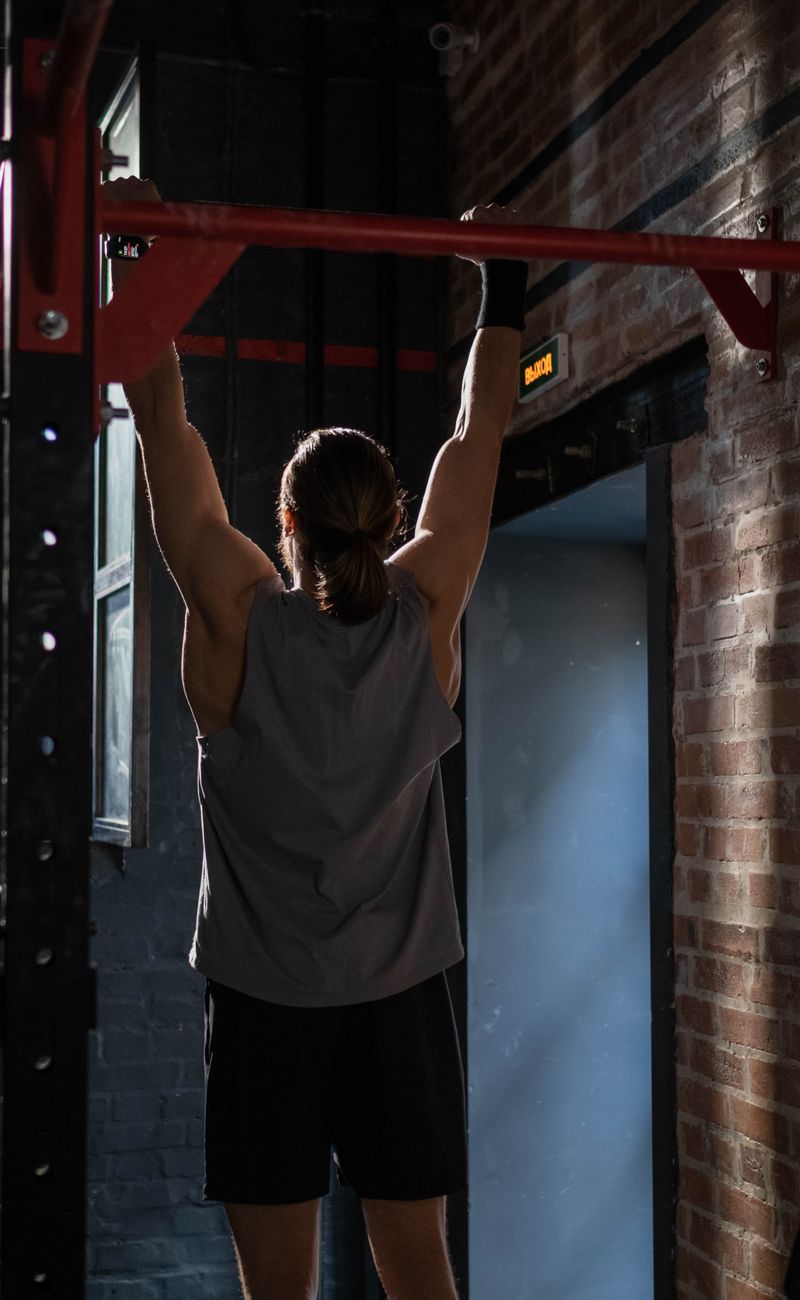
The pull-up is the exercise most lifters do but few do correctly. If your back width is lacking and pull-ups are not in your program, that is your first problem. The pull-up places your entire body weight under tension through your lats, biceps, and entire shoulder girdle. No machine replicates the stabilization demands or the range of motion control that a properly executed pull-up requires.
Most lifters fail to develop back width from pull-ups because they treat it as an arm exercise. You pull with your biceps and you cheat the range of motion by kipping or half-repping. A real pull-up for back width starts from a dead hang with your shoulders fully elevated, your chest proud, and your core braced. You initiate the movement by depressing your scapulae and then drive your elbows toward your hips as you pull your chin over the bar. You lower under control until your arms are fully extended and your shoulders are at the bottom of the movement. That is one rep.
If you cannot perform 10 strict pull-ups, you have a pulling strength deficit that will limit your back development. Build up to that standard using assisted variations, negatives, or high-rep sets with whatever range of motion you can control. The goal is to eventually load your pull-ups with additional weight once you hit 15 plus clean reps. Adding 25 pounds to a pull-up and performing sets of 6 to 8 is a completely different stimulus than doing 50-pound machine pulldowns for 12 reps. The neurological demand and the loading pattern through the lats are not comparable. Do the pull-up. Earn the width.
Horizontal Pulling: The Secret Weapon for Lat Width
Vertical pulling gets most of the attention in back width discussions, but horizontal pulling movements are where serious back width is built. The barbell row, the dumbbell row, and cable row variations all place your lats under load in a stretched position that vertical pulling patterns simply cannot replicate. When you pull a weight toward your torso with your elbows flared out to your sides, your lats are forced to work through their full contraction range while resisting the load.
The chest-supported row is the single most underutilized back width exercise in commercial gyms. Most lifters perform bent-over rows with excessive lower back rounding and minimal lat engagement because their hip hinge position collapses under load. The chest-supported row removes the hip hinge from the equation entirely. You set up on an incline bench with your chest pressed against the pad, you let your arms hang straight down, and you pull the weight to your lower chest or upper abdomen by driving your elbows back toward your hips. The lat stretch at the bottom of each rep and the full contraction at the top create a stimulus for width that no machine row can match.
The chest-supported dumbbell row allows for a greater range of motion than a cable row and eliminates the momentum cheating that sabotages bent-over barbell rows. Perform sets of 8 to 12 with a controlled eccentric, pause at the top of each contraction, and lower the weight over a three-second count. If you are not growing from horizontal pulling, you are likely using too much weight and too little range of motion. Drop the load, control the rep, and let your lats do the work they were designed to do.
Straight Arm Pulldowns: Isolation That Actually Matters
Isolation exercises have a reputation for being ineffective for strength and size because most lifters use them with poor technique and insufficient tension. The straight arm pulldown is the exception. When performed correctly, this movement places direct mechanical tension on your latissimus dorsi without significant bicep involvement because your elbows maintain a fixed angle throughout the range of motion.
The setup matters more than the weight. You want to position yourself so your lats are stretched at the start of the movement. Your hips should be slightly forward of your torso, your arms are extended overhead, and your lats are elongated under tension. From that position, you pull the handle down by depressing your scapulae and contracting your lats hard, stopping when your arms are parallel to the floor. You do not pull the handle to your waist and you do not bend your elbows to cheat the weight up. You squeeze at the bottom and control the weight back to the stretched position.
Straight arm pulldowns work best as a finisher after your compound pulling movements. When your lats are pre-fatigued from rows and pull-ups, the straight arm pulldown allows you to extend the time under tension and accumulate more mechanical work on the target muscle. Use a slow tempo, focus on the mind-muscle connection, and perform 3 to 4 sets of 12 to 15 reps. The pump you get from this movement is not just temporary fullness. It is a genuine signal for muscle growth when combined with progressive overload over weeks and months.
Programming Your Back Width Work: Volume, Frequency, and Progressive Overload
You cannot do back width exercises randomly and expect results. Your back responds to accumulated volume over time, and that requires a structured approach to programming your pulling work. Most intermediate lifters who complain about a narrow back are not doing too few exercises. They are doing too many exercises with insufficient quality and no progressive overload protocol. If every set feels the same as it did three months ago, your back has no reason to change.
For back width specifically, you need at least 12 to 20 hard sets per week distributed across vertical and horizontal pulling movements. That sounds like a lot until you realize that a single working set of pull-ups, rows, and pulldowns each performed for 3 to 5 sets adds up quickly. The key is managing fatigue across sessions. If your back width exercises are destroying your recovery on the days you train them, you are either using too much intensity on your accessory work or not sleeping and eating enough to support the training volume.
Progressive overload for back width does not always mean adding weight. It means accumulating more mechanical tension over time through increased reps, sets, weight, or time under tension. If you performed 3 sets of 8 with 100 pounds on chest-supported rows last month, you should be targeting 3 sets of 9 or 10 with 105 pounds this month. If you are still at 3 sets of 8 with 100 pounds, you are maintaining, not building. The logbook tells the story. Open it before every session and close it only after you have recorded exactly what you did.
Common Mistakes That Kill Back Width Progress
The most common mistake is treating back width exercises as arm exercises. Every time you pull a weight toward your body by bending your elbows first, you shift the load away from your lats and onto your biceps. Your lats are a horizontal adductor and depressor of the arm. They move your upper arm, not your forearm. When you set up for a row or a pulldown, think about pulling with your elbows, not your hands. Drive your elbows toward your hips and squeeze your shoulder blades together at the top of every pulling movement. Your hands are just hooks.
Another critical error is neglecting the stretched portion of each rep. Your lats have the greatest mechanical advantage at the bottom of a pulldown or the start of a row when they are elongated. Most lifters rush through the eccentric phase and miss the opportunity to load the muscle when it is most capable of handling tension. Control every rep down. The negative matters as much as the positive.
Finally, do not ignore unilateral work. Single-arm rows and single-arm pulldowns expose imbalances you cannot feel when both arms are working together. If your left lat is significantly weaker than your right, bilateral exercises will always allow your dominant side to compensate. Dumbbell rows and single-arm cable pulldowns correct imbalances and ensure that both sides of your back contribute equally to your V-taper. asymmetry in your back width is asymmetry in your training. Fix it by logging both sides.
Build the Back Width That Creates the V-Taper
You do not need a special program. You do not need a new supplement. You need to add the right back width exercises, apply progressive overload, and log your work with the same precision you apply to your deadlift or your bench press. The V-taper is a structural goal and structural goals require structural work. Pull-ups, chest-supported rows, and straight arm pulldowns done with consistent effort over time will reshape your back. There is no shortcut. There is only the work.
Start with pull-ups twice per week until you can hit 15 clean reps. Add chest-supported rows for 3 to 4 sets after your vertical pulling work. Finish your back sessions with 3 sets of straight arm pulldowns and focus on the squeeze at the bottom. Track your weights, your reps, and your sets. If you are still narrow after six months of this approach, the problem is not the exercises. The problem is that you are not doing them with enough intent, consistency, or progressive overload to force adaptation. Your back is waiting. Go build it.